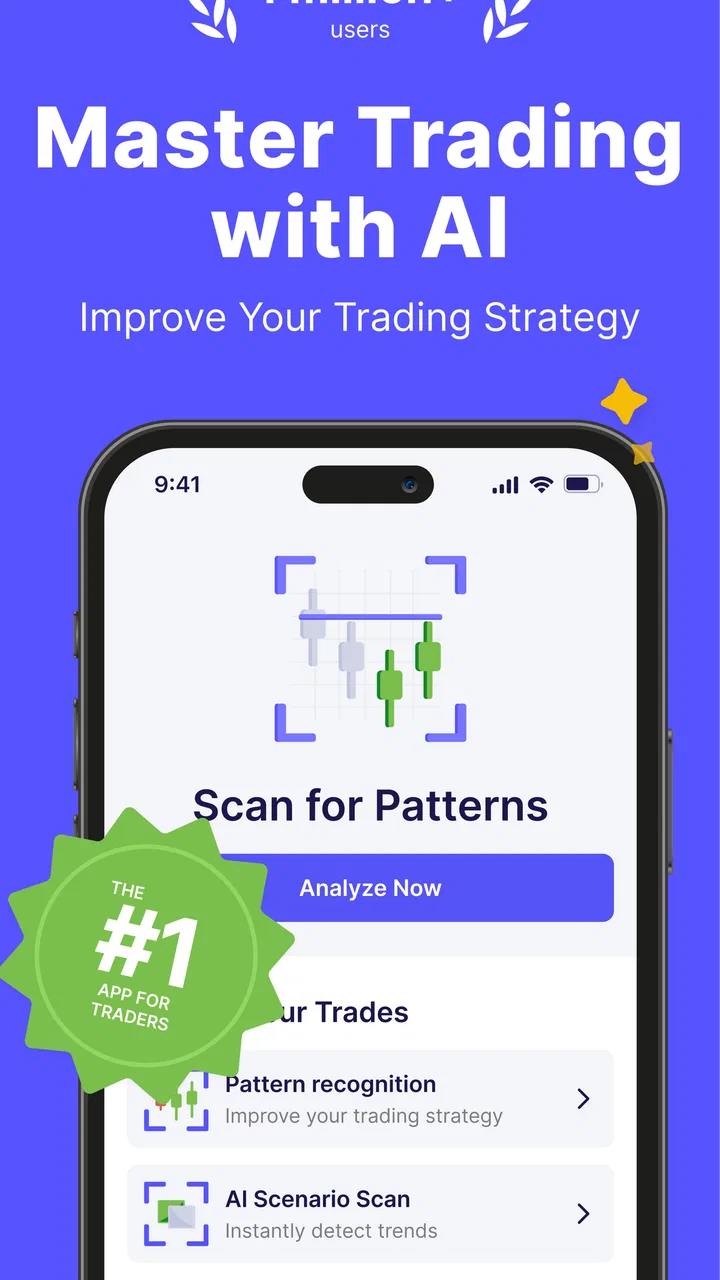
Finelo: Master Trading
- 4.3
- Rating
- 1.00M
- Installs
- Free
- Price

 Analysis by App-foxy
I approached Finelo: Master Trading as something I could use in a household rather than as a shortcut to instant market success. It is an education app from Finelo Limited, aimed at people who want to understand trading, practise reading charts, and explore tools that bring artificial intelligence into the learning process. My overall impression is that it works best as a guided study companion, not as a substitute for judgement, financial planning, or professional advice.
The app is free to download, which makes it easy to try without committing money at the start. Its audience is marked as Teen, so it may appear suitable for older teenagers as well as adults, but that label should not be confused with financial readiness. Trading involves risk, and a young user may understand the lessons without being prepared to act on them responsibly. In a shared home, I would treat Finelo as an educational resource that deserves conversation around it, especially if several people use the same device.
How Finelo fits into a shared household routine
A realistic use case is a household where one person is curious about markets, another wants to understand what the first person is studying, and a teenager is exploring finance for the first time. Finelo can give the conversation a common starting point: instead of passing around random videos or social-media claims, each person can look at the same learning environment and discuss what a chart appears to show.
You May Also Like

 Blood Strike: 2.5 Anniversary
Blood Strike’s Loadouts Turn Every Drop Into a Tactical Gamble
A close look at Blood Strike’s custom loadouts: how fast access to signature weapons reshapes its battle royale rhythm, rewards preparation, and narrows the gap between fights.

 Pandora - Music & Podcasts
Pandora’s Music Is Easy to Start, but Harder to Recover
Pandora’s strength is its low-effort path from a seed to a station. Its weak spot is how much confidence it asks you to place in connection, setup, and quiet recovery.

 8 Ball Pool
 Is Built on Rivalries, Rematches, and Routine
A close look at the rivalries, rematches, shared routines, and unanswered safety questions that turn a quick pool match into a persistent mobile community.

 Samsung Music
’s Quiet Strength Is Playing What You Already Own
Its reach comes less from spectacle than from dependable access to a personal library. That simplicity is both the app’s strongest retention engine and its ceiling.

 AccuWeather: Weather Radar
AccuWeather Review: A Quick, Clear Forecast for Everyday Decisions
For everyday plans, the best forecast is the one you can understand quickly. AccuWeather makes rain timing, radar, and local conditions easy to act on, with a few trade-offs.

 Hill Climb Racing
Why Hill Climb Racing Still Turns Crashes Into One More Run
A tiny car, a bumpy hill and one more upgrade: Hill Climb Racing keeps resurfacing because its simple chaos makes every near-miss feel personal.
More From Our News Desk



I would not use one shared session as if it represented the whole household. Trading education is personal because each learner has a different level of knowledge, tolerance for uncertainty, and reason for opening the app. One person may be studying chart patterns, while another is only trying to learn vocabulary. Keeping those goals separate makes the experience less confusing and reduces the chance that one person’s enthusiasm influences everyone else.
The most useful household arrangement is simple. Each user should have a clear boundary around what they are learning, what conclusions they are drawing, and whether they are merely studying or considering a real financial decision. Finelo can support discussion, but it should not become a shared command centre where one person interprets an AI suggestion and everyone treats it as an instruction.
That distinction matters because the app’s appeal comes partly from its combination of learning material, expert-oriented tools, and AI chart analysis. Those features can make market study feel more approachable, but they can also make uncertain information look more authoritative than it really is. I found the best approach was to ask, “What is this helping me notice?” rather than, “What trade is this telling me to make?”
Starting without turning the app into a financial decision
For a first session, I would begin with the educational side and deliberately postpone any attempt to act on market ideas. A new learner benefits more from understanding price movement, trend language, risk, and the limits of chart-based reasoning than from immediately searching for a promising opportunity. This is one of the main ways I would introduce Finelo to someone in my home: curiosity first, decisions later.
A practical routine is to spend a short session learning one concept, then explain it aloud in ordinary language. If the explanation depends entirely on words such as “signal,” “momentum,” or “breakout” without a clear understanding of the risk involved, the learner probably needs more study. This makes the app useful for building confidence while also exposing false confidence, which is an important difference.
I also recommend keeping notes outside the app about what was learned and what remains uncertain. That may sound basic, but it prevents a learner from confusing repeated exposure with genuine understanding. When an AI chart analysis appears convincing, writing down the reasoning forces the user to separate the observation from the conclusion.
My strongest recommendation is to treat every chart interpretation as a question to investigate, never as a guaranteed answer. That habit is valuable for solo users and even more important when several people are sharing a screen.
Account boundaries and the shared-device question
Households often share tablets or phones, and that creates a practical issue: one person’s learning history, preferences, or in-app progress may be visible to another person using the same device or session. I would avoid assuming that a shared device automatically creates separate personal spaces. Before making Finelo part of a family routine, I would check how the app handles sign-in and user separation in the current version, then make sure each person knows whose account is active.
This is not just about privacy. Clear account boundaries also improve learning. If one person opens a session shaped by another person’s interests, the material may feel oddly chosen or the learner may mistake someone else’s progress for their own. A household can prevent this with a simple habit: sign out or switch deliberately when changing users, and say out loud which learner is currently using the app.
I would also keep payment responsibility separate. Finelo is free to start, but it includes in-app purchases ranging from $9.99 to $99.99 per item. On a shared device, that makes accidental or misunderstood purchases a household matter rather than a minor technical detail. Adults should discuss who is allowed to buy anything, which account is connected to the store, and whether a teenager should use the app only for free learning.
The important point is that the app’s free entry does not mean every part of the experience is cost-free. I would explore the basic experience first, decide whether it genuinely improves learning, and only then consider whether any paid option is worthwhile. A purchase should expand a clear study plan, not be made because a market-related screen creates urgency.
Coordinating learning without copying trades
Finelo is easier to use well when the household agrees on what coordination means. I would coordinate study times, share questions, and compare explanations. I would not coordinate by copying a person’s trade idea simply because they appear more confident or because an AI-assisted chart view looks persuasive.
One effective exercise is to have two learners inspect the same chart independently and write down what they notice before discussing it. The goal is not to see who predicts the market correctly. The goal is to identify where interpretation begins, where assumptions enter, and which risks each person has overlooked. This turns the app into a tool for critical thinking rather than a competition.
Another useful approach is to assign different roles. One person can explain the basic concept, another can challenge the interpretation, and a third can ask what would make the conclusion wrong. Even when only two people are involved, alternating these roles keeps the discussion balanced. It also reveals whether the learner understands the reasoning or is merely repeating the app’s terminology.
I would be careful with household authority. A parent, partner, or older sibling may have more financial experience, but that does not make every market opinion correct. Finelo can help everyone learn a shared vocabulary, yet it should not be used to give one household member automatic control over another person’s money.
This is where the app compares favourably with casual finance videos and social feeds. Those alternatives often encourage passive watching and confident personalities. Finelo’s educational framing and chart-oriented tools are more useful when I want to pause, inspect an idea, and discuss it. On the other hand, a structured course or book may be better for someone who wants a carefully sequenced theory curriculum without interactive market tools.
Teen use, trust, and responsible expectations
The Teen content rating makes Finelo approachable for younger users, but I would still introduce it with adult guidance. A teenager can use the app to learn how markets are described, why prices fluctuate, and why risk management matters. That does not mean they should be encouraged to open a brokerage account, follow signals, or treat trading as an income plan.
Trust works better here than surveillance. I would ask the young user to show what they are studying and explain what they think it means. If the answer is clear, the conversation can move toward deeper questions. If the answer is “the app says this will go up,” that is a good moment to discuss uncertainty, alternative explanations, and the difference between analysis and prediction.
Adults should also be honest about their own limits. Presenting Finelo as a way to become an expert quickly would create the wrong expectation. The app can make difficult ideas easier to approach, but learning to interpret charts is not the same as knowing how an individual investment will perform. A teenager especially needs to hear that distinction repeatedly without being made to feel foolish for asking questions.
I would skip Finelo for a young user who is already focused on quick profits, copying online personalities, or using money they cannot afford to lose. The issue would not be the app alone; it would be the user’s current motivation. In that situation, a general personal-finance course focused on budgeting, saving, and compound growth would be a better first step than a trading-oriented platform.
What the AI chart analysis adds—and where it can mislead
The AI chart analysis is the feature that most clearly separates Finelo from a plain glossary or traditional beginner course. It gives the learner a way to engage with charts rather than only reading definitions. I found that useful when I wanted to connect an abstract lesson with something visual and ask why a particular pattern might attract attention.
Its weakness is also obvious: visual clarity can feel like certainty. A chart is a compressed record of past price behaviour, and an AI explanation can organise that information neatly without removing the unpredictability of future events. I would therefore use the analysis as a second opinion for learning, not as the primary reason to enter or exit a position.
A good workflow is to form your own initial view, inspect the app’s analysis, and then list what the analysis does not settle. For example, an interpretation may help identify a trend or a possible level of interest, but it does not by itself answer whether the asset suits your finances, how much risk is acceptable, or what news could change the picture. This three-step process is more educational than opening the AI tool first and accepting its framing.
That workflow is a concrete advantage for experienced learners too. Someone who already knows basic chart language can use Finelo to challenge a first impression and explain disagreements. A complete beginner, however, may need more foundational instruction before the chart tools become genuinely helpful. Without that foundation, the app could encourage pattern hunting instead of disciplined analysis.
Everyday usability and the cost question
Finelo’s free price makes experimentation straightforward, and its popularity is reflected in an average rating of 4.5 from around 36 thousand ratings, with roughly 4.5 thousand written reviews. More than 500 thousand installs also suggest that it has reached a substantial audience. I see those figures as signs that the app is worth investigating, not as proof that it will suit every learner.
The purchase range deserves careful attention because the difference between trying an app and committing to paid learning can be significant. I would not decide based on the presence of advanced-sounding tools alone. I would first ask whether the lessons are changing how I think, whether I can explain the concepts without the app open, and whether I have a specific reason to need more than the free experience.
The app is marked as version 1.26.3 and requires iOS or Android 10 or newer. That is useful to know before planning a shared household setup, particularly if an older phone or tablet is involved. A family may have a modern primary phone but an ageing spare device, so compatibility should be checked before assuming everyone can study on whichever screen is available.
I would also remember that a trading-learning app can consume attention even when it does not cost money. If a user starts checking charts repeatedly throughout the day, the educational purpose can quietly turn into compulsive monitoring. Setting a study window is healthier than allowing market screens to dictate the household’s routine.
Who should choose it, and who should look elsewhere
I think Finelo is a strong fit for an adult beginner who wants more structure than scattered online clips and more interaction than a static book. It is also useful for a learner who is comfortable questioning AI output and wants to connect lessons with chart-based examples. In a household, it can support thoughtful conversations when each person keeps their own account boundaries and financial decisions.
It is less suitable for someone seeking guaranteed signals, instant income, or a fully automated trading system. It is also not my first choice for a person whose main need is budgeting, debt reduction, retirement planning, or broad financial literacy. The app’s trading focus could distract from those priorities, even if the user enjoys the interface.
Compared with a conventional online course, Finelo appears more immediate and tool-oriented, especially for chart practice. Compared with free video platforms, it offers a more focused environment and fewer distractions from unrelated content. Compared with a book, it is likely to feel more active, but a book may provide deeper continuity and a calmer pace. I would choose between them based on the learner’s weakness: use Finelo for engagement and visual practice, and add a structured course or reliable book when theory and context need more depth.
For a teenager, I would use it only alongside conversations about money and risk. For a household with a shared device, I would establish account and purchase rules first. For an experienced trader, I would view it as a supplementary learning and analysis aid rather than a replacement for a broader research process.
My household verdict
After using Finelo as a learning tool, I would recommend it to a curious person who wants to understand trading more clearly and is willing to treat every analysis as provisional. The combination of education, chart work, and AI-assisted interpretation gives it more practical character than a basic finance reference app. Its free starting point also lowers the barrier to testing whether that style of learning suits you.
My recommendation comes with firm boundaries. Keep users separate on shared devices, discuss purchases before they happen, and do not let a Teen rating become an excuse to skip adult guidance. Most importantly, do not confuse a polished chart explanation with a promise about the future. The app is at its best when it helps you ask better questions and recognise your own assumptions.
For my household, that makes Finelo worthwhile as a shared conversation starter, but not as a shared decision-maker. I would install it for study, set expectations before anyone explores paid features, and pair it with broader financial education. Used that way, it can make trading concepts less intimidating while preserving the caution that real money decisions require.
FAQs for Finelo: Master Trading
01What features does Finelo: Master Trading offer to enhance my trading experience?
Finelo: Master Trading provides a comprehensive suite of features designed for both novice and experienced traders. It includes real-time market data, advanced charting tools, customizable alerts, and a diverse range of trading instruments. Additionally, users benefit from an intuitive interface, educational resources, and a demo account to practice strategies without financial risk.
02Is Finelo: Master Trading suitable for beginners in trading?
Yes, Finelo: Master Trading is designed to accommodate users of all skill levels. Beginners will find the app's user-friendly interface and extensive educational resources particularly helpful, including tutorials, webinars, and a dedicated support team to assist with any queries. The demo trading feature also allows newcomers to practice without risking real money.
03What security measures does Finelo: Master Trading implement to protect my data?
Finelo: Master Trading prioritizes user security by employing state-of-the-art encryption protocols to safeguard personal and financial information. The app also uses two-factor authentication (2FA) to enhance account protection. Regular security audits and compliance with industry standards further ensure a safe trading environment for all users.
04Are there any costs associated with using Finelo: Master Trading?
While downloading Finelo: Master Trading is free, users may encounter costs depending on their trading activities. The app may charge fees for certain transactions, such as buying or selling assets. Additionally, premium features or advanced tools might require a subscription. It’s advisable to review the app’s pricing structure for detailed information.
05How does Finelo: Master Trading support users in making informed trading decisions?
Finelo: Master Trading supports informed decision-making through a wealth of resources. It offers real-time analytics, market news updates, and expert insights. The app’s AI-driven recommendations and customizable alerts help users stay ahead of market trends. Furthermore, its community forums allow users to exchange strategies and tips, fostering a collaborative trading environment.
Pros
- User-friendly interface for easy navigation.
- Comprehensive tutorials for beginners.
- Real-time market updates included.
- Customizable alerts for price changes.
- Supports multiple trading platforms.
Cons
- Requires a stable internet connection.
- Advanced features behind a paywall.
- Limited customer support hours.
- Occasional app crashes reported.
- High battery consumption during use.

Finelo: Master Trading
Gallery